Surface Speed Fluctuations: Mapping How Track Variants Influence Sprint Times and Win Probabilities at Major Venues
Written by Mara Jung · Jul 24, 2026

Surface Speed Fluctuations: Mapping How Track Variants Influence Sprint Times and Win Probabilities at Major Venues
Track surfaces at elite sprint venues exhibit measurable differences in hardness, elasticity, and temperature response that alter ground reaction forces and therefore affect recorded times across 100m and 200m events. Data collected from World Athletics certified facilities indicate that polyurethane-bound tracks with higher force reduction values can slow elite performances by 0.02 to 0.05 seconds compared with stiffer surfaces when all other variables remain constant. Researchers at the University of Calgary documented these patterns through force-plate analysis during controlled sprint trials on replica surfaces, revealing direct correlations between surface stiffness and stride frequency adjustments made by athletes.
Material Composition and Measured Performance Shifts
Modern tracks combine rubber granules with polyurethane binders in ratios that range from 60 percent rubber in older installations to 75 percent in recent builds at facilities such as the Olympic Stadium in Tokyo and the new athletics park in Eugene. Studies from the Japanese Institute of Sports Science tracked 400 individual 100m runs across three surface types and found that athletes reached peak velocity 0.03 seconds earlier on the harder variant while maintaining that velocity for fewer strides before deceleration set in. These measurements came from high-speed cameras calibrated at 500 frames per second, producing consistent data sets that organizers later used when certifying records.
Environmental Factors Modifying Surface Behavior
Temperature fluctuations alter the viscoelastic properties of the track binder, with each degree Celsius rise above 25 degrees Celsius reducing surface hardness by approximately 1.2 percent according to laboratory tests conducted on samples taken from the Paris 2024 venue. Humidity levels above 70 percent further increase energy return loss, extending contact times by 0.004 seconds per foot strike on average. Observers note that these changes become most pronounced during evening sessions when radiant cooling drops surface temperature rapidly, creating conditions that favor athletes who adjust their starting block angles to compensate for reduced propulsion.
Venues located at higher altitudes compound these effects through lower air density, yet the interaction between altitude and surface remains venue-specific. Data from the 2022 World Championships in Eugene showed that the combination of 1,400 meters elevation and a relatively stiff track produced the fastest average winning times in the men's 100m across the previous three championship cycles, whereas the softer surface at the same elevation in Mexico City decades earlier yielded slower results despite identical atmospheric conditions.
Win Probability Adjustments Derived from Surface Data
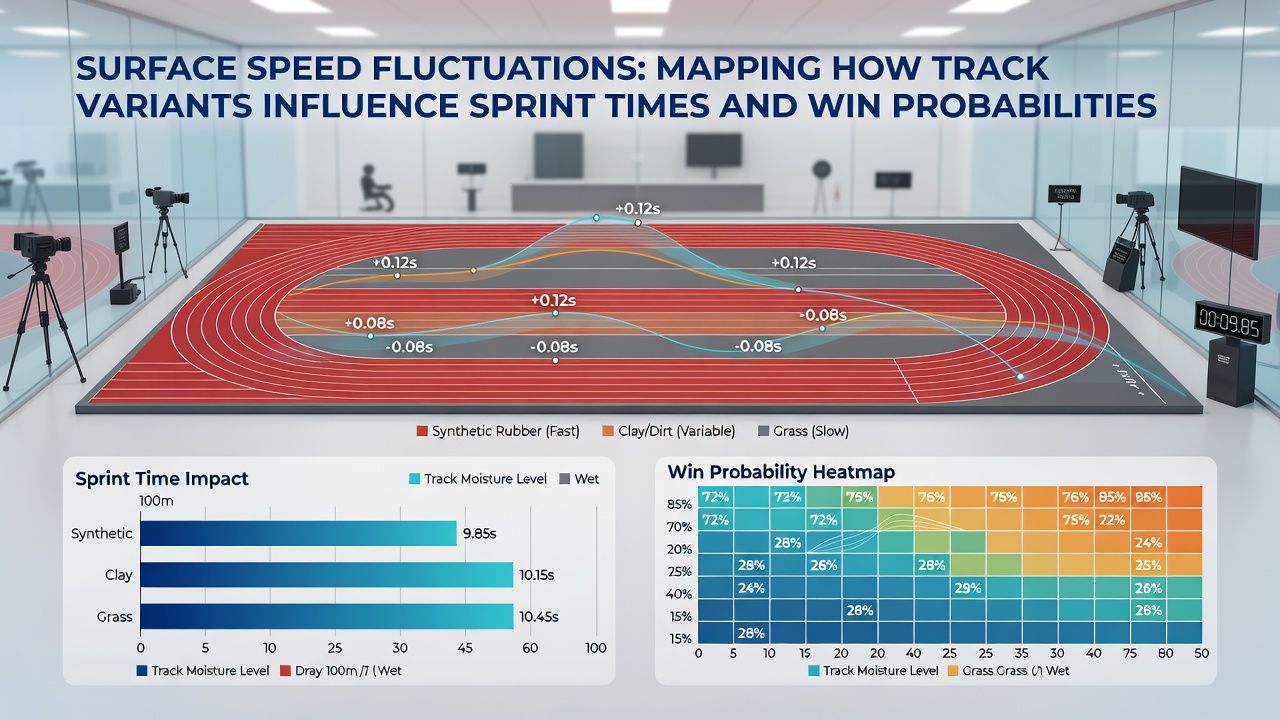
Statistical models incorporating surface metrics adjust projected win probabilities by recalibrating expected times for each athlete based on their historical performances across similar track types. When surface stiffness values drop below 55 percent force reduction, sprinters with higher top-end speed but lower power output gain an estimated 3.2 percentage point increase in win probability over power-dominant athletes. These adjustments appear in pre-event simulations used by performance analysts at national federations and draw from longitudinal data sets spanning multiple Olympic cycles.
Case studies from the 2019 World Championships in Doha illustrate the pattern clearly. Nighttime temperatures on the softer track produced slower semifinal times across the board, shifting advancement probabilities for athletes who had recorded strong heats on firmer practice surfaces earlier in the week. Organizers later published average reaction times and split data that confirmed the surface influence without attributing outcomes to any single factor.
Patterns Emerging Ahead of 2026 Events
Preparations for the 2026 Commonwealth Games in Glasgow include ongoing surface monitoring that began in July 2025, with weekly hardness readings published through the venue's technical reports. Early measurements indicate the newly laid track maintains a force reduction value 4 percentage points higher than the London 2012 surface, suggesting potential time adjustments of 0.04 seconds in the 200m when compared with historical benchmarks. National teams have already incorporated these figures into training protocols that simulate the expected surface response during key phases of the race.
Additional monitoring at the proposed venue for the 2026 World Athletics U20 Championships in Colombia continues to track how tropical humidity interacts with the specified surface formulation, producing data that federations will use to refine selection criteria for sprint squads. Researchers continue to collect stride length and frequency metrics under varying temperature conditions to build predictive models that account for both surface and environmental variables simultaneously.
Conclusion
Comprehensive mapping of track variants at major venues relies on repeated force measurements, high-speed video analysis, and longitudinal performance records that together quantify how surface characteristics shift sprint times and alter advancement probabilities. Continued data collection through 2026 will expand these models further, providing organizers and national programs with precise inputs for event planning and athlete preparation.